

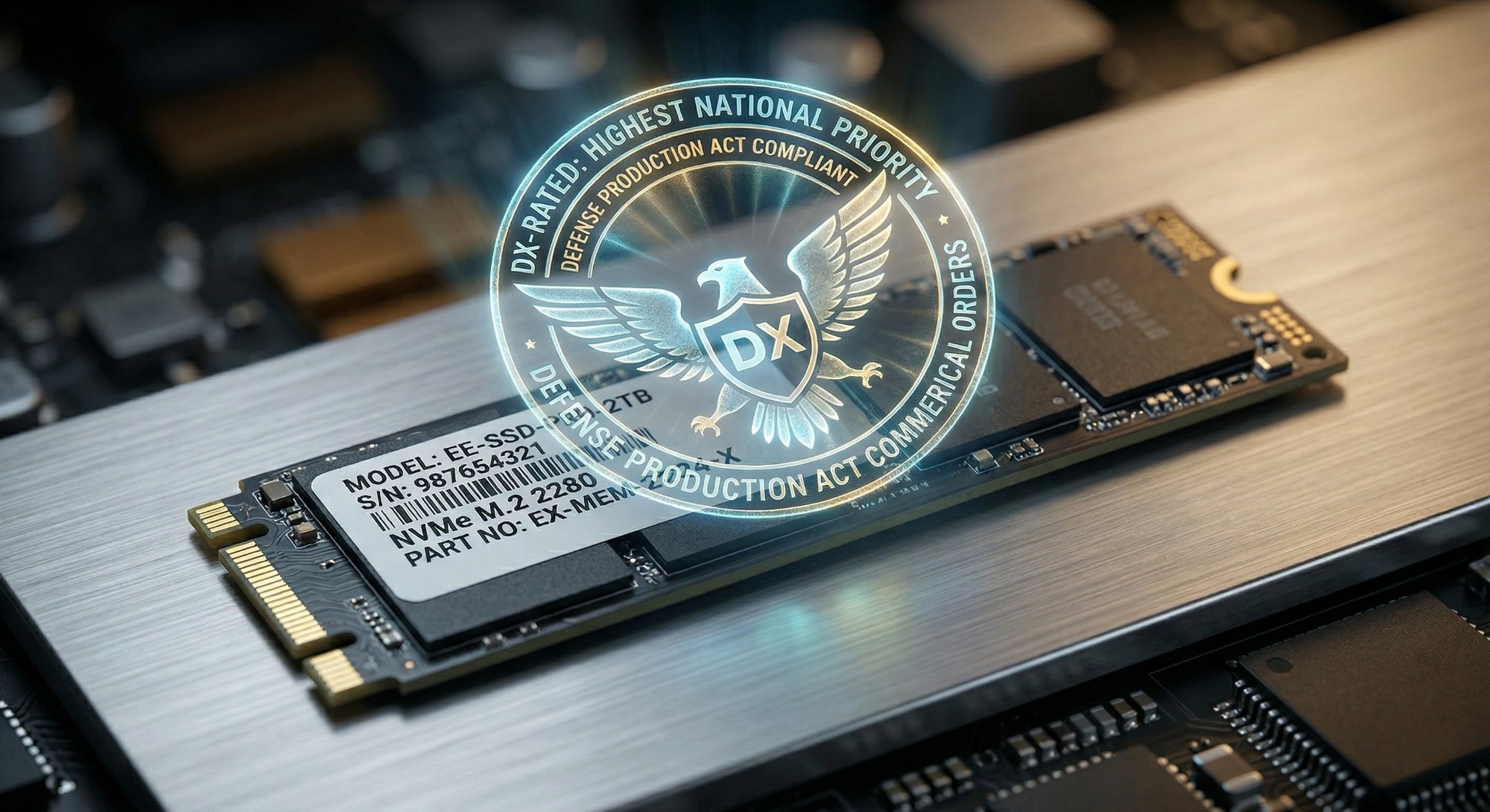
If you've been waiting longer than expected for SSDs, RAM, or other storage components, you're not imagining it.
Supply is tight, demand is high, and lead times across the industry have stretched accordingly. Most people point to data centers, and they're not wrong. Large-scale infrastructure projects are consuming massive volumes of memory and storage. But there's another layer to this story that doesn't get as much attention: DPAS orders.
Understanding how DPAS works won't make the supply crunch disappear, but it will help you understand why your order is sitting where it is in the queue and whether you're entitled to move up in line.
What Is the Defense Priorities and Allocations System (DPAS)?
The Defense Priorities and Allocations System (DPAS, for short) is a federal program administered by the U.S. Department of Commerce under the Defense Production Act. It ensures that orders tied to national defense and critical government programs get fulfilled, even when supply is constrained.
When an order is DPAS-rated, suppliers are legally required to prioritize it over unrated commercial orders. This obligation is codified under federal law, and suppliers have very limited grounds to refuse or deprioritize a rated order.
There are two rating levels:
- DO-rated orders carry a Department of Defense priority. These are tied to programs that support national defense and must be accepted and fulfilled ahead of unrated orders.
- DX-rated orders sit at the highest level of national defense priority. They take precedence over everything, including DO-rated orders.
When a supplier like Micron is allocating inventory, a DX-rated order goes first, followed by DO-rated orders, and then the rest of the commercial queue.
What This Means for the Electronics Supply Chain
Everyone is drawing from the same pool of supply: commercial buyers, government agencies, contractors, and government-funded infrastructure projects. DPAS is a prioritization system within that shared pool, determining who gets served first when there isn't enough to go around.
So even if you've placed a substantial order with an established supplier relationship, an incoming DPAS-rated order will move ahead of yours if it comes in. That's true regardless of volume, contract value, or how long you've been a customer. The rating is the deciding factor.
Do You Have a DPAS Order and Not Know It?
DPAS ratings can be passed through the supply chain. If a prime contractor receives a rated order from a government agency, they're permitted, and in many cases required, to flow that rating down to their subcontractors and suppliers. That means your order may carry a DO or DX rating even if you didn't originate it at the federal level.
The rating will appear on your order documentation, typically as "DO-rated" or "DX-rated" alongside a program identifier and a statement citing the Defense Production Act. If you're not sure what you're looking at, it's easy to overlook.
| Why does it matter? Because a rated order entitles you to prioritized fulfillment. If your supplier isn't treating it accordingly, or if you're not communicating the rating when placing your order, you may be waiting in a longer line than you need to be. |
How Edge Electronics Supports DPAS Orders
At Edge Electronics, we work with DPAS orders, both DO and DX-rated, across a wide range of industries and project types. Whether you're a program manager navigating a government contract or a procurement lead sourcing components for a defense-adjacent infrastructure project, we understand what your order requires and how to execute on it.
Our supplier relationships span a broad network, which means we have more options to work with when standard channels are stretched thin. Our team stays with you through the process, from confirming your order documentation to coordinating delivery on your timeline.
If you have a rated order, we can help you use it. And if you're not sure whether your order qualifies, we’re always available for a conversation. Contact us today.
Frequently Asked Questions
What are valid grounds for a supplier to reject a DPAS-rated order?
Under 15 CFR Part 700, valid grounds include situations where acceptance would violate another federal law, where the supplier doesn't normally produce or stock the item, or where fulfillment is technically impossible given current capacity.
Conflicting commercial commitments or lower margins don't qualify. Rejections must be communicated promptly and in writing, and the Department of Commerce can challenge any rejection it considers improper.
Can a DPAS rating be applied retroactively to an existing purchase order?
Yes. A rating can be placed against an existing unrated order, upgrading its priority from the date the rating is received. This doesn't automatically displace work already in progress for other rated orders, but the supplier is required to adjust their schedule to accommodate the newly rated obligation.
What happens if a supplier fails to comply with a rated order?
Non-compliance is a violation of the Defense Production Act. The Department of Commerce can investigate and refer cases to the Department of Justice, where penalties can include fines or imprisonment. Suppliers are also required to retain records of rated orders and fulfillment for a minimum of three years.
How does DPAS interact with export control regulations like ITAR or EAR?
DPAS priority does not override ITAR or EAR requirements. A rated order for export-controlled components still requires all applicable licenses and authorizations before fulfillment. If an export license is pending, the supplier should communicate that to the customer and the relevant government authority rather than shipping without proper authorization.
If I'm a subcontractor, am I required to flow the rating down to my own suppliers?
Generally, yes. When a prime contractor extends a DPAS rating to a subcontractor, that subcontractor assumes the same obligations as the original rated order holder. If sourcing materials from their own suppliers is necessary to fulfill the order, the rating must be flowed down accordingly. It cannot be used to prioritize work unrelated to the original rated program.
Does Micron Carry DPAS-Rated SSDs?
DPAS refers to the order priority, not the component itself. A DPAS-rated Micron SSD order would be prioritized over a non-DPAS order, but it would need the DPAS classification to qualify. If a company orders through Micron that doesn't have DPAS priority, their order falls into the standard queue.