

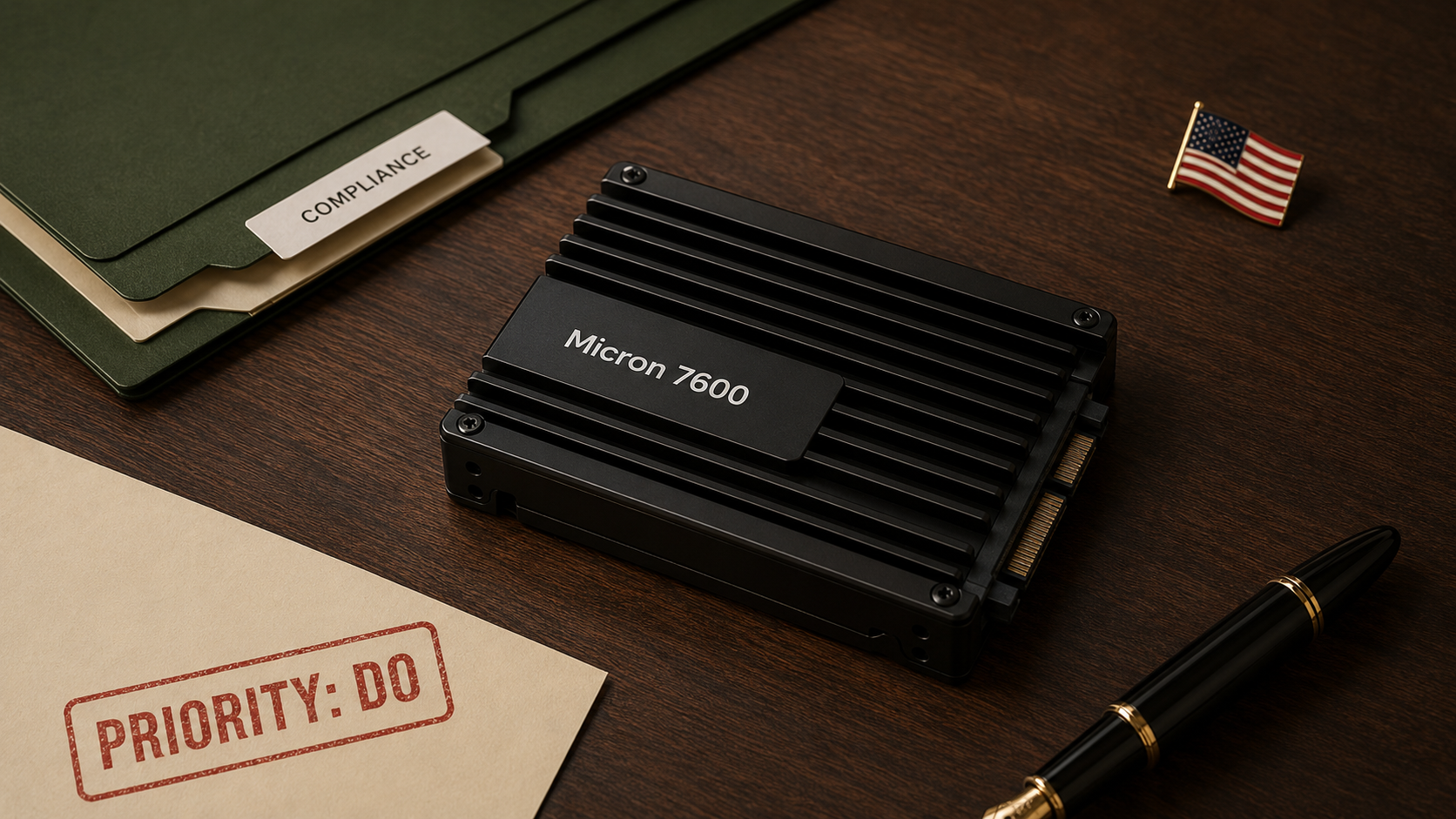
DPAS, DFARS, and TAA. They sound similar, they often appear in the same contract, and they get conflated, but they do very different things. One prioritizes your order in the national industrial base, one flows contractual requirements down your supply chain, and one governs where the product was made.
This guide walks through what each framework actually requires, how they interact on a single Micron SSD or memory order, and what to ask your distributor before the PO goes out.
What Do DPAS, DFARS, and TAA Each Actually Require?
DPAS, DFARS, and TAA are three separate U.S. federal frameworks that can all apply to the same defense procurement. DPAS prioritizes rated orders in the supply chain, DFARS flows defense acquisition requirements down through subcontractors, and TAA restricts the country of origin for products sold to the federal government.
| Framework | What It Requires | What the Buyer Needs from the Distributor |
|---|---|---|
| DPAS Defense Priorities and Allocations System |
Priority handling of orders, marked DX or DO, that support approved national defense and emergency preparedness programs | Acceptance of the rating, flow-down to the manufacturer, and scheduling consistent with priority |
| DFARS Defense Federal Acquisition Regulation Supplement |
Compliance with the specific DoD acquisition clauses flowed down in the contract, commonly covering cybersecurity, country of origin, and specialty metals | Familiarity with the specific clauses flowed down, and documentation that satisfies them |
| TAA Trade Agreements Act |
Country-of-origin restrictions for products sold under federal contracts over the TAA threshold. Products must come from the U.S. or a TAA-designated country | Country-of-origin documentation and sourcing from TAA-designated countries |
What Is a DPAS Rating and How Does It Affect Micron Memory Orders?
A DPAS rating is a priority designation (DX or DO) assigned to orders supporting approved U.S. national defense or emergency preparedness programs. The rating tells every supplier in the chain, from distributor to manufacturer, to prioritize the rated order ahead of unrated work.
The rules are set out in 15 CFR Part 700. A few points matter for memory procurement:
- DX beats DO beats unrated. DX is the highest priority and is reserved for a small number of designated programs. DO is the common rating on most defense contracts. Unrated orders are everything else.
- Acceptance or rejection has a deadline. A supplier receiving a rated order generally has 15 working days to accept or reject it (10 days for DX). Acceptance obligates the supplier to schedule and deliver consistent with the rating.
- Ratings flow down. When a distributor accepts a rated order, the rating has to be passed through to the manufacturer and any sub-tier supplier supporting the order.
- The rating travels on the PO. The buyer is responsible for putting the rating symbol, program identifier, and required certification language on the purchase order.
For Micron memory specifically, this means a distributor taking a DPAS-rated order for Micron SSDs, DRAM, or NAND has to accept the rating, flow it down to Micron, and schedule the order consistent with the priority. Not every distributor is set up to do this routinely, but Edge Electronics handles DPAS-rated orders and flows the rating down to Micron as part of standard order processing.
What Does DFARS Compliance Mean for Micron Memory?
DFARS is the Defense Federal Acquisition Regulation Supplement. It’s the set of clauses that extend and modify the Federal Acquisition Regulation (FAR) for Department of Defense contracts. When a buyer says a Micron order needs to be "DFARS compliant," they almost always mean one of a handful of specific clauses that have been flowed down in the prime contract.
The clauses most often invoked for memory and electronic components include:
- DFARS 252.204-7012: Safeguarding Covered Defense Information and Cyber Incident Reporting. Requires contractors and subcontractors handling covered defense information (CDI) to implement NIST SP 800-171 controls and report cyber incidents within 72 hours. Relevant when compliance documentation or technical data for a program moves through the distributor.
- DFARS 252.225-7009: Restriction on Acquisition of Certain Articles Containing Specialty Metals. Less commonly a concern for COTS memory than for mechanical assemblies, but it can appear on integrated systems.
- DFARS 252.225-7001 and 252.225-7036: A family of country-of-origin clauses (Buy American and Balance of Payments Program; Buy American—Free Trade Agreements—Balance of Payments Program). These sit in the same DFARS family as the Trade Agreements clause (252.225-7021), with the contracting officer selecting one based on contract value and whether a covered trade agreement applies.
DFARS clauses flow down. If the prime contract contains 252.204-7012, the prime is required to flow that clause to subcontractors and suppliers who will handle covered defense information. A distributor supporting a DFARS-flowed program has to understand which clauses apply to its scope, have the internal controls to meet them, and deliver documentation through channels that don't break the requirement.
Edge Electronics is familiar with DFARS flow-down. A distributor supporting a 252.204-7012 program has to understand which clauses apply to its scope and deliver compliance documentation in a way that fits the program's requirements, which should be coordinated with the prime upfront.
What Makes a Micron SSD TAA-Compliant?
A Micron SSD is TAA-compliant when it has been manufactured or "substantially transformed" in the United States or in a TAA-designated country. The Trade Agreements Act restricts what the federal government can buy under contracts above a dollar threshold.
A few points that matter when sourcing Micron memory under TAA:
-
TAA is about the country of origin. A product from a U.S. manufacturer can still be non-TAA if final assembly happens in a non-designated country. The reverse is also true.
-
"Substantially transformed" is the legal test. The country of origin is where the product's essential character was established, typically where the die was assembled into the finished SSD, module, or component.
-
Country of origin appears on compliance documentation. Buyers should expect country-of-origin information on the packing slip, on a Certificate of Origin when requested, and on the commercial invoice for international shipments.
-
Not every Micron part is TAA-compliant. TAA status varies by product line and manufacturing location. Buyers asking about Micron's enterprise SSDs, like the 7450, 7500, and 7600 series, are the most common procurement questions. For more information, we maintain a current list of TAA-compliant Micron SSDs.
How Do These Three Frameworks Interact in a Single Order?
In real procurement, these frameworks rarely appear alone. A typical defense Micron order might look like this:
A Tier 1 defense prime is building a system for a DoD program. The contract carries a DO rating under DPAS, flows DFARS 252.204-7012 down to handle covered defense information, and requires TAA-compliant sourcing. The prime needs a quantity of Micron 7600 enterprise SSDs for the build.
The PO that lands on the distributor's desk now has to satisfy all three:
- The rating has to be accepted and flowed down. The distributor has 15 working days to accept the DO rating. Acceptance commits them to schedule the order consistent with the priority and pass the rating through to Micron.
- The country of origin has to be confirmed. The specific Micron 7600 part numbers on the PO have to be TAA-compliant, and country-of-origin documentation has to travel with the shipment.
- Compliance documentation has to move through a controlled channel. If the program involves covered defense information, documentation exchange (Statements of Volatility, RoHS, REACH, CMRT, country-of-origin letters) has to happen in a way that satisfies DFARS 252.204-7012 and any ITAR or EAR flow-down on top of it.
What to Ask Your Micron Distributor Before Placing a Rated Order
A short checklist before the PO goes out:
- Are you authorized by Micron? Authorization matters for warranty, traceability, and direct access to Micron's compliance library.
- Can you accept a DPAS-rated order? Confirm the acceptance process, lead time, and how the rating is flowed down to Micron.
- Can you provide country-of-origin documentation on the specific part numbers I'm ordering? TAA status is per part number and per manufacturing location, so you should ask for documentation on specific parts.
- Can you deliver compliance documents through a secure channel? Programs under DFARS 252.204-7012, ITAR, or EAR flow-down require controlled document exchange.
- Are you familiar with DFARS flow-down? The distributor should be able to talk about the specific clauses in your contract without handing you a generic response.
- Do you carry supplier-diversity certifications? Primes pursuing diverse-supplier spend goals often need a WBE, MBE, or SDVOSB in the chain for the order to count toward their reporting.
If the distributor can't answer these cleanly on a first call, the order is going to be slow.
How Edge Electronics Supports DPAS, DFARS, and TAA Micron Procurement
A Micron order under DPAS, DFARS, or TAA is a coordination problem as much as a sourcing problem. The PO has to be received, rated, flowed down, scheduled, and documented, often in parallel, under a tight clock. Edge Electronics is set up for that pace.
Our team accepts DPAS-rated orders, flows ratings down to Micron on receipt, and schedules against the priority. We’re familiar with DFARS flow-down language and can confirm on a first call which clauses we can meet and which ones sit with the prime. TAA status is verified at the part-number level before the quote goes out, with country-of-origin documentation traveling on the PO.
Edge is ISO 9001-certified, providing compliance teams with an auditable quality system to reference. We’re also WBENC-certified as a Women's Business Enterprise, which counts toward the supplier-diversity spend reporting primes are increasingly held to.
If you're scoping a Micron order under any combination of DPAS, DFARS, or TAA, send us the part numbers, the rating, and the flow-down language from your contract. We'll come back with what we can source, the documentation we'll provide, and a realistic schedule.