PCIe generation sets the throughput ceiling for a storage design. Moving from Gen4 to Gen5 roughly doubles available bandwidth, and Gen6 doubles it again. The Micron 9650 is the first PCIe Gen6 data center SSD in mass production, opening new performance options for AI training, inference, and high-density infrastructure.
This guide compares three Micron NVMe SSD families: the Micron 7600 for mainstream Gen5 deployments, the Micron 9550 for maximum Gen5 performance, and the Micron 9650 for Gen6 bandwidth. It covers specifications, workload fit, form factors, qualification, and procurement considerations for OEM and contract manufacturing programs.
Quick takeaway: Choose the 7600 when latency consistency and mainstream Gen5 efficiency matter most, the 9550 when you need peak performance on a mature Gen5 platform, and the 9650 when your validated Gen6 system can use maximum storage bandwidth.
The PCIe Generation Landscape
What Changes Between PCIe Generations?
NVMe SSDs connect to host systems through PCIe lanes. Each generation roughly doubles raw per-lane bandwidth, although real SSD throughput also depends on the controller, NAND architecture, firmware, workload, power, and thermal conditions.
PCIe generation bandwidth and deployment status
| PCIe Generation |
Per-Lane Bandwidth |
Approximate x4 Bandwidth |
Typical Deployment Era |
Status |
| Gen4 |
2 GB/s |
8 GB/s |
2019 to 2023 |
Mature and production-stable |
| Gen5 |
4 GB/s |
16 GB/s |
2022 to present |
Active deployment |
| Gen6 |
8 GB/s |
32 GB/s |
2025 to present |
Mass production with Micron 9650 |
Backward Compatibility and Platform Validation
PCIe supports backward-compatible link negotiation, but installing a newer drive in an older system does not guarantee complete platform compatibility. The drive may operate at the older link speed, and the system must still support the drive's physical form factor, connector, firmware, power, thermal, and signal-integrity requirements.
- Confirm the CPU and platform's native PCIe generation.
- Verify that the server supports the required E1.S, E3.S, or U.2 form factor.
- Review firmware and BIOS qualification before selecting a production part number.
- Evaluate power delivery, airflow, heat sinks, liquid cooling, trace length, retimers, and connector quality.
Micron Gen5 and Gen6 SSDs: Drive-by-Drive Breakdown
These three families address different points in the data center storage market. Maximum specifications vary by capacity, endurance class, and form factor.
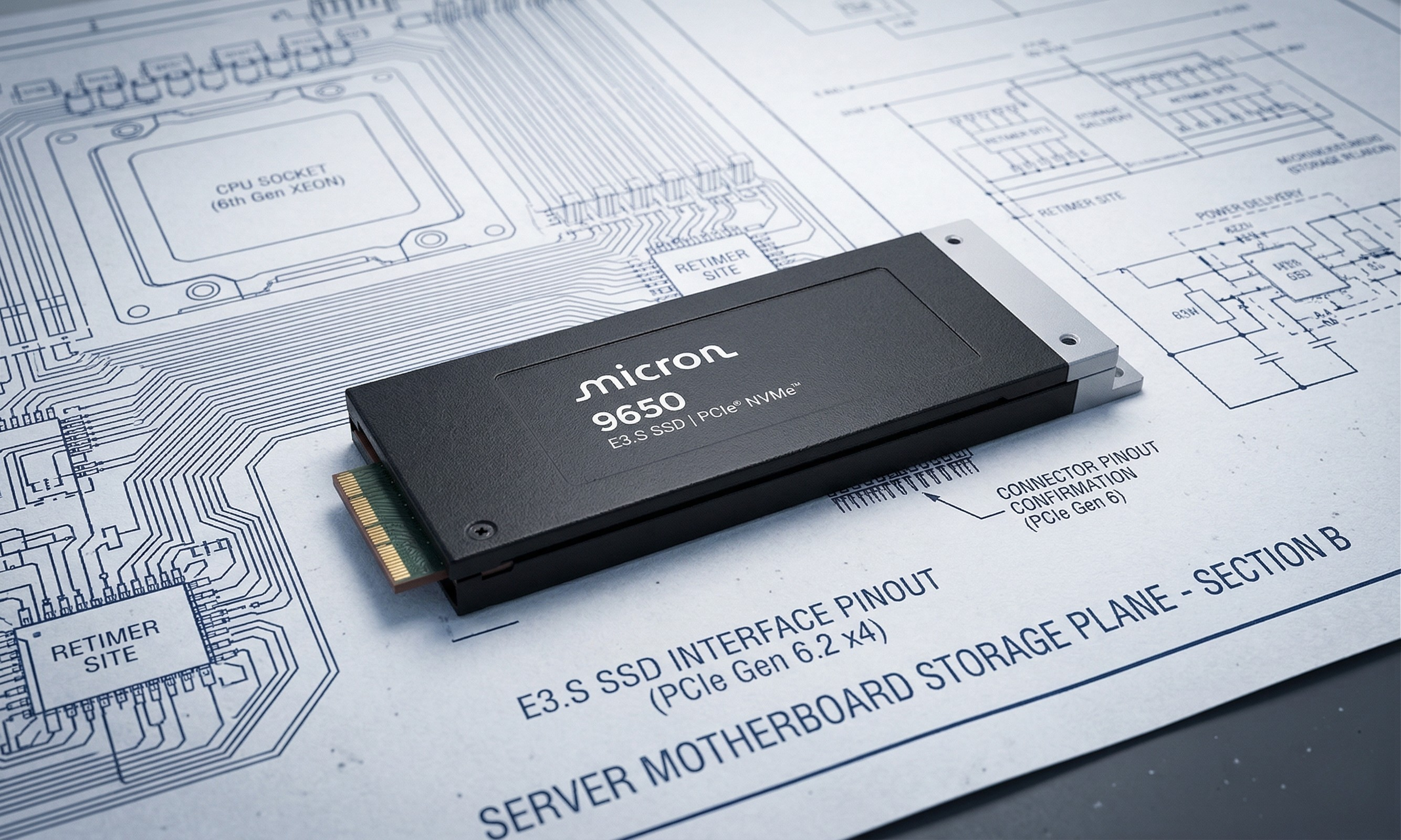
Micron 9650: Maximum PCIe Gen6 Performance
PCIe Gen6
9650 at a Glance
- Interface: PCIe Gen6 x4, NVMe 2.0
- Sequential read: Up to 28 GB/s
- Sequential write: Up to 14 GB/s
- Random read: Up to 5.5 million IOPS
- Random write: Up to 900,000 IOPS
- Power: Up to 25W
- NAND: Micron G9 TLC
- Form factors: E1.S 9.5mm and E3.S 1T
- Capacities: 6.4TB to 30.72TB
- Endurance: PRO 1 DWPD and MAX 3 DWPD
- Cooling: Air-cooled and liquid-cooling options
- Security: SED, FIPS, and TAA options
The Micron 9650 is designed for systems that can use Gen6 bandwidth, especially AI training, inference, GPU data pipelines, high-performance computing, and other workloads that need exceptionally fast access to large datasets.
The E1.S option supports liquid cooling, while the E3.S option supports high-density air-cooled deployments. Start platform qualification early because Gen6 operation depends on the complete server architecture, not only the SSD.
Micron 9550: Peak PCIe Gen5 Performance
PCIe Gen5
9550 at a Glance
- Interface: PCIe Gen5 x4, NVMe 2.0
- Sequential read: Up to 14 GB/s
- Sequential write: Up to 10 GB/s
- Random read: Up to 3.3 million IOPS
- Random write: Up to 400,000 IOPS
- NAND: Micron G8 232-layer TLC
- Form factors: U.2, E1.S, and E3.S
- Capacities: 3.2TB to 30.72TB
- Endurance: PRO 1 DWPD and MAX 3 DWPD
- Security: SPDM 1.2, SED, FIPS, and TAA options
The 9550 is the performance-focused choice for engineers who need maximum Gen5 bandwidth on widely deployed Gen5 infrastructure. It supports AI, high-performance databases, caching, online transaction processing, and other demanding workloads.
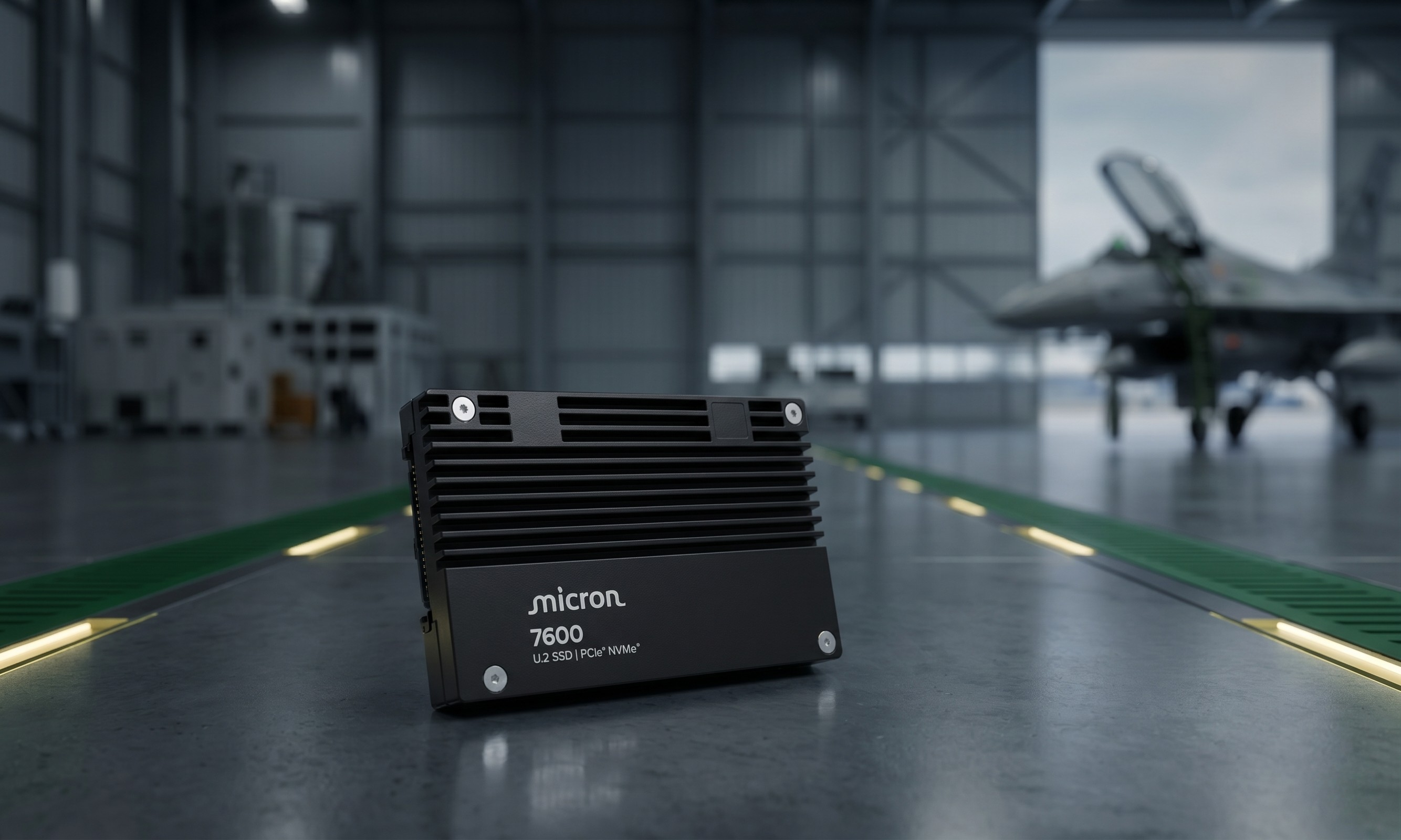
Micron 7600: Mainstream PCIe Gen5 with Strong QoS
Mainstream Gen5
7600 at a Glance
- Interface: PCIe Gen5 x4, NVMe 2.0b
- Sequential read: Up to 12 GB/s
- Sequential write: Up to 7 GB/s
- Random read: Up to 2.1 million IOPS
- Random write: Up to 675,000 IOPS
- NAND: Micron G9 TLC
- Form factors: U.2, E1.S, and E3.S 1T
- Capacities: 1.6TB to 15.36TB
- Power: Typically 20W to 25W
- Standards: OCP 2.6, SPDM 1.2, and TCG Opal 2.02
The 7600 emphasizes low latency, predictable quality of service, and strong performance per watt. It is well suited to databases, OLTP, cloud instances, virtualized systems, AI inference, web services, and mixed workloads where response-time consistency matters more than maximum sequential bandwidth.
Maximum performance comparison for Micron 7600, 9550, and 9650 SSDs
| Metric |
Micron 7600 |
Micron 9550 |
Micron 9650 |
| Interface |
PCIe Gen5 x4 |
PCIe Gen5 x4 |
PCIe Gen6 x4 |
| Sequential read |
12 GB/s |
14 GB/s |
28 GB/s |
| Sequential write |
7 GB/s |
10 GB/s |
14 GB/s |
| Random read |
2.1M IOPS |
3.3M IOPS |
5.5M IOPS |
| Random write |
675K IOPS |
400K IOPS |
900K IOPS |
| NAND |
Micron G9 TLC |
Micron G8 TLC |
Micron G9 TLC |
| Power |
Typically 20W to 25W |
Up to 25W |
Up to 25W |
| Liquid cooling |
No dedicated option |
No dedicated option |
E1.S option |
| Primary strength |
Latency and QoS |
Peak Gen5 performance |
Maximum Gen6 bandwidth |
Values are maximum published figures and vary by capacity, form factor, endurance class, workload, and configuration. Confirm the specifications for the exact part number selected for your program.
Form factor compatibility depends on the host platform. Confirm the slot, connector, height, power, heat sink, serviceability, and cooling requirements before finalizing a drive.
Form factors available in Micron 7600, 9550, and 9650 SSD families
| Form Factor |
Approximate Dimensions |
Available Families |
Typical Fit |
| U.2, 15mm |
69.85 x 100.4 x 15mm |
7600 and 9550 |
Broadly deployed 2.5-inch enterprise drive bays |
| E1.S, 9.5mm |
31.6 x 111 x 9.5mm |
7600, 9550, and 9650 |
Hot-plug EDSFF; 9650 offers a liquid-cooling option |
| E1.S, 15mm |
31.6 x 111 x 15mm |
7600 |
Mainstream EDSFF deployments requiring additional heat-sink volume |
| E3.S 1T, 7.5mm |
76.1 x 112.75 x 7.5mm |
7600, 9550, and 9650 |
High-density, serviceable enterprise storage |
Which Micron Data Center SSD Fits Your Workload?
Recommended Micron SSD family by workload requirement
| Primary Requirement |
Recommended Drive |
Why It Fits |
| Maximum AI training and inference throughput on a validated Gen6 platform |
Micron 9650 |
Maximum bandwidth and IOPS with Gen6 |
| High-performance AI and HPC on established Gen5 infrastructure |
Micron 9550 |
Peak sequential and random-read Gen5 performance |
| Latency-consistent OLTP, databases, and mixed workloads |
Micron 7600 MAX |
Predictable QoS with mixed-use endurance |
| Read-intensive cloud and analytics with strong power efficiency |
Micron 7600 PRO |
Mainstream performance and power efficiency |
| Highest capacity in this Gen5 comparison |
Micron 9550 PRO, 30.72TB |
Maximum capacity with high Gen5 performance |
| Multi-year deployment plan built around Gen6 infrastructure |
Micron 9650 |
Gen6 performance with PRO and MAX options |
NVMe SSD Procurement and Qualification Considerations
Selecting the drive family is only part of the decision. Production programs also need to account for platform qualification, lifecycle, security, compliance, and supply.
Production Longevity
Confirm lifecycle expectations, forecast timing, firmware requirements, and the exact production part number before qualification. Edge can help align the selected configuration with the program timeline.
Platform Qualification
Qualification should cover link speed, firmware and BIOS support, I/O compatibility, power, thermals, signal integrity, security, and the physical drive carrier or bay.
Security and Compliance
SED, FIPS 140-3 Level 2, TAA, SPDM, and related options vary by family and part number. Review the exact configuration rather than assuming every combination is available.
OCP and Management
The 9550 provides broad OCP 2.0 support with OCP 2.5 telemetry capabilities. The 7600 and 9650 move to OCP 2.6 features for current data center management and security requirements.
For a broader introduction to SSD technologies, see Edge's comprehensive SSD guide. For government and defense programs, review Edge's TAA-compliant Micron SSD information.
Not Sure Which Drive Fits Your Program?
Tell Edge about your host platform, workload, capacity, form factor, security requirements, and production schedule. Our team can help identify the appropriate drive family and available product variant.
Request Technical Help and Pricing
About Edge Electronics
Edge Electronics is an ISO 9001-certified, Certified Women's Business Enterprise and authorized Micron distributor serving OEMs, contract manufacturers, government agencies, and engineering teams.
Edge's in-house Field Application Engineers support product selection, platform qualification, transition planning, and long-term production programs. Micron has recognized Edge FAE Keith Peterson for outstanding technical support.
Working with Edge Electronics:
- Authorized Micron distribution
- In-house technical and application support
- Part-number and configuration assistance
- Lifecycle and transition planning
- Availability, lead-time, and pricing support
- Samples for qualified programs
Use Edge's authorized distributor's guide to Micron SSDs to compare additional enterprise and client families.



.png)
.png)